Showing posts with label Commentary. Show all posts

26 January 2013

Noel's Account of Crossing Canada in 1931 - Audio

When I first wrote about Noel's crossing through Canada on his way to the YMCA conferences in Toronto and Cleveland, I didn't remember that I had more first-person information about the trip to share.

In 1982, when I was only 12, I made an audio tape of my grandfather, Noel, recounting some family history, including a story about his trip through Canada with the Hawaiian delegation on the way to the YMCA conferences.

It's been a learning process for me to get the recording off the cassette tape and into a digitized format that I can share, but I'm finally finished with it.

So, below is a YouTube video link of Noel telling the story, plus a transcript of the recording. I hope you find it interesting.


Noel: "In 1931 when I came over to America, when we arrived in Honolulu, about 30 young Hawaiian boys got on the boat. They were going to the World Conferences of YMCAs in Toronto and Cleveland. And so, I being by myself, I joined them. And, they were singing Hawaiian songs and everything on the boat from Hawaii to Vancouver.

"And, when we got to Vancouver, I stayed at the same hotels they stayed at. We were invited to a basket-- a baseball game and we sang at intermission -- at half time we sang Hawaiian songs in the stands.

"And then, we traveled on the same train, the Canadian Pacific into the Rockies, and I traveled with them. And we sang in the First Class section to amuse the First Class people on the train. And we got into the observation cars, you know, with the glass roofs.

"And then, when we got to the station for Lake Louise, we got off there as guests of the management, and we stayed one night at the Chalet at Lake Louise. In return for that, we sang on the terrace at sunset."

Haley: "And by then, you knew all the Hawaiian songs."

Noel: "That's right. And then the next day, we all piled into a bus, and they took us the 40 miles to the Banff Springs Hotel. And we stayed overnight there and in return for that we sang on the terrace of the Banff Springs Hotel.

"And when we continued, then, we had a special car on the train for us all the way to Toronto."

10 January 2013

Noel's College Journey

In pursuing this letters project, I’m constantly trying to unearth the back story that makes the letters more interesting. And because the letters are only one side of a conversation, I sometimes have to search a little to make sense of the conversation.

In several of the recent letters, George has commented on Noel’s school work and grades. Luckily, Noel left us some clues on those subjects in some of the papers he saved.

Some of those papers help paint the picture of the steps Noel took to attend college in the United States. More of those papers show how he did when he actually got to college. In the next two posts I will try to paint some of this back story, and then fill in the other side of the conversation.

~~~

If I were writing Noel's story as a novel, there are a couple moments that strike me as being a great place to start the book.

Noel identified one of those moments himself when he wrote, later in his life, about his relationship with his former girlfriend, Kath Lilford:
“On June 19, 1931 the Hughes Family together with Kathleen gathered at Spencer Street Railroad Station to bid Noel ‘God Speed’ and a successful college future. Even now in 1986, I can still visualize the group, and Kath in particular, standing there as the train pulled out of the station.”
Another place to start the story would be only six days prior to that departure, 13 June 1931, when Noel received word that he had officially been accepted into the YMCA Training College in Chicago.


It's the telegram that seemingly set everything in motion: "HUGHES ADMITTED UNCLASSIFIED STUDENT".

The time up to that event must have been filled with tremendous uncertainty. A letter from the YMCA acknowledging Noel's resignation from his position there is dated 10 June 1931, before the confirmation telegram even arrives, so there might have been an indication that the acceptance was coming. Or the letter is dated wrong.

Regardless, his immigration visa in his passport is dated 15 June 1931, and George's first letter is dated 19 June 1931, the same day Noel boarded a train for Sydney.

All this paints a picture of a very stressful and hasty time planning a life-changing decision to travel half way around the world to attend college.  What would Noel have done if he hadn’t been accepted? Would he have made the journey to attend the World YMCA conferences in Toronto and Cleveland anyway, and then returned home? Would he have attended university in Melbourne and pursued a career in the YMCA? Would he have married Kath Lilford?

~~~

Why did Noel choose to go to school in Chicago?

From the letters, it’s apparent that some Australians who were serious about a career in the YMCA sought training in the United States.

As best as I can tell from the letters and a little online research, there were two YMCA training colleges in the United States that the YMCAs in Australia tended to use. One was in Chicago (The Young Men’s Christian Association College, later George Williams College, and today part of Aurora University) and the other in Springfield, Mass. (Springfield College). 

According to a History of George Williams College on the website of the Kautz Family YMCA Archives, University of Minnesota Libraries:
"In 1890, when full-time YMCA work was becoming professional, requiring more intensive training, a year-round 'Training School' was established under the same leadership. The new school was located in Chicago, Illinois and was greatly influenced in its human service mission by the social and educational changes going on in that rapidly growing, industrial city.

"While evangelism and 'Christian work' was clearly at the heart of both the YMCA and the training school, the work of the association was never dissociated from a social service purpose. The service mission was one of sensitivity to problematic social situations young men faced as they migrated from the rural families and communities to an urban industrial environment."

If Noel was intent on pursuing a career as a YMCA secretary, like his father, the two training colleges in the United States seemed like good options. But the Melbourne YMCA experience with Springfield College seems much stronger.

Ivor Burge, a colleague of Noel's at the YMCA of Melbourne, had just returned from Springfield a few years prior.

More tellingly, George writes in Letter No. 12:
“We have had good word from Dr. Doggett, concerning the four Australians at Springfield. He writes in the highest terms of the four men -- Evans, McRae, Jones and Laing, and of course asks for more. I think you have got to do your share in building up a tradition in connection with the Chicago Y College. Now that Glover and yourself are in the student body, it is up to you to endeavor to secure the interest of other men so that the number at Chicago may be increased.”
With such a strong existing relationship between the YMCAs in Australia and Springfield College, I’m not sure why Noel chose to attend school in Chicago. Perhaps it was because of Clive and May Glover and the fact that Clive was studying in Chicago. I haven’t determined the relationship the Hughes family had with the Glover family, but based on passing references in the letters, there seems to be a family friendship, and the Glovers were a tremendous help to Noel on his arrival.

So, that’s the best I can determine at the moment as to why Noel chose Chicago.

~~~

Noel also left us some clues as to what he had to do to get accepted into the college.

A copy of a letter from Melbourne High School
that Noel used in his admission packet to college.
Noel was not an exceptional student in high school. According to a letter of reference from Melbourne High School, he achieved a Sub-Intermediate rating on his completion of school. 

In the unsigned copy of a letter from someone at Melbourne High School, that person explains, “The standards are – Sub-Intermediate, Intermediate, and Leaving Certificate, in that order, a pass at Leaving qualifying for entrance to the University.”

The Australian high school tradition and the U.S. college admissions didn’t even seem to speak a common language when it came to evaluating students and their academic achievements, and translation had to be done.

“This is the nearest approximation I can make to your system of ‘credits’,” writes the Melbourne High School contact.

It appears that Noel only had 2 years of high school, which may have been fairly normal at that time. I’m not sure. But it seems short, especially for someone who was college bound. The family moved from New Zealand to Melbourne in March 1924. Noel would have been 14 years old. He attended Melbourne High School in 1924 and 1925, which means he would have been 16 at his completion.

According to his recommendations from the Melbourne YMCA, he worked with the YMCA for over four years before he left for the United States in 1931. So he started that affiliation probably in 1926.  

Letter No. 1 from Stott's Business College
He attended Stott’s Business College in Melbourne 1926-27, where he studied bookkeeping, shorthand and typing. According to his reference letter from CH Holmes, the principal of the college: “I might mention that we always found Hughes to be a well conducted boy, and well liked by both his fellow students and teachers.” 

In 1931 he started studying with George Taylor & Staff. According to the letter from Geo. Taylor: Noel “has been doing revisionary work with us during the current year in Arithmetic, Algebra, History, Geography, and English with a view to attaining the Intermediate standard of the Melbourne University in these subjects.”

Letter No. 2 from Stott's Business College
The letter from Stott’s Business College is dated 5 Feb 1931 and addressed specifically to the Chicago Y College. The letters from Melbourne High School and George Taylor & Staff are both dated in April 1931. 

It’s clear Noel started exploring the decision to go to Chicago by early 1931, but he also might have had an alternate plan to pursue admission to Melbourne University. 

Letter from George Taylor & Associates
But even though Noel was accepted to the Chicago YMCA Training College, there was still a lot of uncertainty about his education when he left for the United States. On his arrival he had to take an entrance exam. In George’s letters to Noel as Noel is making his journey to Chicago, George frequently reminds Noel to study for that exam.

And despite all of George’s connections with the YMCA, he did want Noel to succeed on his own. In Letter No. 15 --  29 Sep 1931, he writes: 
“I have not written to the College authorities regarding yourself, because I felt that it was not right for me to use my position in any way to secure additional recognition for you. I will, however, write them shortly. By now you will have had your entrance status determined, and your plans laid out for your school work.”
Chicago Y College Certificate of Admission
How did Noel do with his entrance exam? It was determined that he lacked one year of high school credit, so his scholarship was conditional on him completing four units of high school work within two years.

In Letter No. 29, George makes a very telling remark in response to Noel’s advice to his little sisters: 
“I am rather amused at your reference to ‘make them study’. I wish to goodness I could have drummed the same thing into your head when you were here! I tried hard to get you to realise that you were taking things far too easily, and trusting to pot luck to get through on the American end. Now you realise how essential it is to have adequate preparation so as to get advanced standing.”
~~~

All this leaves me wondering:

Can anyone offer insight into how the high school certification program in Melbourne might have worked when Noel attended in 1925? What does it mean to be Sub-Intermediate? To finish when you are 16?

How does one apply to a college half way around the world when mail moves at the speed of a ship?

And do I have to go through the University of Minnesota Libraries to view a Chicago Y College Catalog from 1931?

Coming soon: Noel's coursework and grades

16 August 2012

Jacko the Broadcasting Kookaburra

Advertisement for
the Australian National Travel Association
with a kookaburra sitting on a record album.
(Courtesy of the National Library of Australia
and the State Library of Victoria.
J. Kercheval, photographer.)

In the last few letters, specifically Nos. 22 an 23, it's apparent that Noel is gearing up to do presentations about Australia to various groups in Chicago.

There are references to the famous Aboriginal preacher, inventor and writer David Unaipon, plus various literature about Australia.

The reference that really caught my interest this time was about  the "Kookaburra record" in letter No. 23 from 28 Dec 1931.

"In your last letter you asked me to secure a copy of the Kookaburra record. I was able to get this from the Australian National Travel Association, although I understand that copies cannot be procured in the ordinary gramaphone stores. We tried it out on our own machine at home and it is quite good."

My first thought was of the children's song "Kookaburra sits in the old gum tree." But it turns out that song hadn't been written or recorded yet. That would be a little later in the 1930s.

So that left me puzzled. Fortunately, George mentioned the Australian National Travel Association, and an internet search turned up "Jacko, the Broadcasting Kookaburra." And the pieces fell into place.

It turns out that early Australian radio used to regularly broadcast the sound of a kookaburra, which is a variety of kingfisher bird native to Australia. The call resembles a mad laugh.

The bird that recorded that call also became quite famous and was known as Jacko, the broadcasting kookaburra. He and his exploits inspired a children's book a few years later.

The article I found about Jacko, the Broadcasting Kookaburra, written by Jerry Berg for OnTheShortWaves.com, is very interesting. Here is a relevant excerpt, but I suggest clicking through and reading the entire article:

``In 1933, a children's book entitled "Jacko, the Broadcasting Kookaburra­-His Life and Adventures," was published by Angus and Robertson Ltd. in Sydney, Australia. ... The author is Brooke Nicholls... .

There is an author's note at the start of the book that reads as follows: "This is the true story of Jacko, the Broadcasting Kookaburra, that so many of his fellow Australians have heard laughing over the air from the wireless stations of Melbourne, Sydney, and Brisbane; and from the gramophone record that was arranged and produced by Mrs. Harold W. Clapp for the Australian National Travel Association. The story begins with Jacko's capture in the bush. It tells of his many adventures, and ends with his home-coming after a four-thousand mile caravan journey along the eastern seaboard of Australia. The illustrations and chapter headings are from drawings made by Miss Dorothy Wall, whose exquisite pen has captured the humorous spirit of the story."

KOOKABURRA'S LAUGH. (1931, March 28).
The Mercury (Hobart, Tas. : 1860 - 1954), p. 4.
Retrieved August 17, 2012, from
http://nla.gov.au/nla.news-article29902607
This article led me to search online newspaper archives at Trove.nla.gov.au, where I found a delightful article from 18 March 1931 about how the recording of Jacko's voice was obtained and how the recording would be used to promote Australia abroad. According to the article in The Argus of Melbourne:

"After the wax master-disc had been made it was played in the studio for the benefit of the bird, which was still perched on the chair from which it had laughed into the microphone. The first few notes brought a puzzled expression to tho bird's face; then it lifted its beak and laughed so heartily that it fell fluttering to the floor, where it continued to laugh until the record was taken off the machine."
(KOOKABURRA'S LAUGH. (1931, March 18). The Argus (Melbourne, Vic. : 1848 - 1956), p. 6. Retrieved August 17, 2012, from http://nla.gov.au/nla.news-article4378978

Since Noel was still in Melbourne and preparing to leave for Chicago at the time this article was published, I'm sure that the recording being discussed in the letters must be this one (and the one referenced in the article about the Jacko children's book). Perhaps it is also the very album that the kookaburra is sitting on in the old photograph from the Australian National Travel Association at the top of this page.

Unfortunately, I'm not sure yet if Noel was ever successful in securing a copy of the record.

In letter No. 22 George worried about his ability to get the record safely to Noel. "The phonographic record I will endeavour to get and send on to you, although there may be some problem in packing it securely for transportation to America. I am wondering whether it could not be procured in the States. I will make enquiry regarding that from the Vocalion people."

Then, in an upcoming letter in March, he acknowledges Noel's report that that album arrived cracked.

In letter No. 31, which will be posted at a future date, George writes: "We are sorry to hear that the phonographic record was cracked when it arrived. I knew the thing was packed securely, as I had it specially done with the object of making sure it would reach you in usable condition. Perhaps it may be possible to get one from the San Francisco office of the Australian National Travel Assocn."

I'll update this post if and when I find more references to it in George's letters.

As a point of interest for any non-Australians reading this, here is an example of a kookaburra's call and laugh from YouTube:


10 August 2012

Camps Manyung and Buxton (Shoreham)

Melbourne (Point A) to Camp Manyung (Point B)
to Camp Buxton at Shoreham (Point C).
(Map data ©2012 Google, Whereis(R), Sensis Pty Ltd)
The next few letters have a lot of information about the progress of the YMCA camps at Shoreham, and especially Manyung.

It took me a little bit of research to appreciate the references to the camps in these letters. Both camps are on the Mornington Peninsula south of Melbourne, and were quite new in 1931-32. Camp Buxton, which George refers to by its location, Shoreham, is long since closed, but Camp Manyung is still around and is an active YMCA camp.

"The Camp Manyung complex is one of two permanent camps which demonstrates the YMCA's involvement in the welfare of young people and their families over more than 70 years in Victoria," according to the heritage website On My Doorstep. "In its scale and grand vision for future development, Camp Manyung demonstrates the strong commitment of the YMCA to youth camping in Victoria. It is the only remaining early Victorian property managed today by the YMCA as the city headquarters has been demolished and Camp Buxton is now in private ownership."

As George is writing his letters and mentioning the camps, it is around the Christmas and New Years holidays.

Since I'm from the Chicago area, my first instinct is to think of these camps in context of the Northern Hemisphere. I have to remind myself that the Christmas and New Years holidays occur during a hot season in Australia, and there is a strong tradition of going to the beach around this time. These camps offer a cooler summer getaway for the residents around Melbourne.

Camp Manyung

Camp Manyung is still an operating YMCA camp, and is deemed to be of historical significance to the state of Victoria. The YMCA's website is the best place to go for information about its present operations and photos.

In looking up the history of the camp, a name that is frequently referenced in George's letters comes up as being instrumental to the development of the camp -- Ivor Burge.

According to one history about the camp found online titled "Camp Manyung History": "Burge (who had just returned from America) came up with the idea of a permanent camp like the ones he had seen in America. He asked an architect to plan the camp layout and design the bunkhouses. It was decided that the camp would be built by volunteers because the YMCA did not have the money to pay for it."

This volunteer effort is evidenced by frequent references in George's letters.

Also according to On My Doorstep, many innovative programs were developed at the camp, including leadership training and family camps.

In 1993, The National Council of YMCA's of Australia published a book by Ian F. McLaren, titled "Camp Manyung, Mornington: a brief history". It's an 18 page booklet. Unfortunately, I do not have access to any copies here in Chicago, but copies are available in the libraries of Monash University and the State Library of Victoria. If anyone wants to look at the booklet, I'm curious what it might say about the camp's history, especially as it relates to George's time period, the 1930s.

Camp Buxton

Y.M.C.A. Holidays for Country Boys
Gippsland Times (Vic. : 1861 - 1954)
25 November 1946, page 5
courtesty of the National Library of Australia
In Shoreham, on land that is now largely preserved as a forest preserve, was Camp Buxton. Some of the buildings remain, converted into a bed and breakfast. The camp closed after the mid 1970s, as best as I can determine.

"The YMCA Camp, Shoreham ... was in ideal setting, only an hour's drive from Melbourne and five minutes from the beach. On arrival the campfire looked like a tent city with numerous tents and huts scattered all around the central marquee... " This is one description of the camp I found in an article about a retreat at the camp in 1975.

Of course, the best reference I found for information about Camp Buxton is a website written by Robert Pedula, who stayed at the camp in the 1950s. He has put together a nice history and photo gallery, and is the source of much of my information.

16 July 2012

Noel's video illustrations

I don't have any original letters written by Noel during the time period of George's letters, but I do have a different treasure. Among the family papers I inherited were several reels of 8mm film dating back to 1936 when Noel acquired a camera. These films are up to 75 years old, so they have deteriorated.

I have sent many of them out to ScanDigital to be digitized, and hope to do the rest as money allows.

Among the films are some great illustrations of things that Noel (via George) is describing now, such as the Push Ball contest mentioned in Letter No. 22. It's a crazy affair and the video is quite entertaining to watch, I think.

Here is Noel's video of the Push Ball contest from what appears to be 1936 (five years after the one described in letter No. 22).


Also, here is Noel's footage of the Drexel Avenue campus of the Chicago YMCA College, which is soon renamed to George Williams College, where Noel is attending school.


These two clips were part of a longer video that isn't really relevant to the letters right now, but you can view it in its entirety here, if you want.

You'll notice that in Letter No. 22, George mentions that Noel has been doing presentations about Australia while in Chicago, so I think it's safe to make the leap that the video about the college above and the one below are meant to be for presentations about Chicago and George Williams College on Noel's return to Australia after graduation. (Spoiler: Noel stays in the United States and does not move back to Australia.)


Here is that other film I mentioned, a video tour of Chicago in 1936/37. This helps set the scene for where Noel is living and what he is experiencing.


You will probably see me link to these videos again in the future. I can't help it. I think they are fun. And I hope you enjoy them, too.

03 May 2012

George is feeling testy?

George doesn't usually express much emotion in his letters -- his language is always so civilized -- but in this letter (No. 20), a little testiness and frustration leaks through. It's subtle, even if George does come close to swearing at one point.

"I wish to goodness we could do something with that blessed amplifier, but seemingly it is impossible to dispose of it."

You could hardly blame him, though. The letter if full of examples of how the Depression is hitting the family. Keith and Rex are barely able to hold onto jobs. George is hoping that Joyce can stay in a free school, and is having to drop piano lessons for the girls. The YMCA's finances are a mess.

And here is George's youngest son, half a world away. He knows Noel is extremely low on funds and he hasn't heard from him in two months. George scrapes together $10 to send to Noel, and laments that he can't liquidate the amplifier, which is worth about $300.

The Argus (Melbourne),
Tuesday 17 November 1931, page 7
But that's not the only example of testiness. When talking about Henley Day, George issues a rare complaint.
"I personally would rather have gone to Henley-on-the-Yarra, but mother has determined to go with the kiddies so I suppose I will have to do likewise."

Of course, I had to look up Henley Day, and it turns out the Henley-on-the-Yarra was a huge regatta on the Yarra River, attracting up to 300,000 in 1925, according to a history site about the Yarra River. It was also a major social event.

So when you consider what an avid sportsman George was, it seems only natural that he would complain about missing a major sporting event.

Maybe I'm just getting better able to read George now that I'm 20 letters into this project, or maybe the stresses of the time are getting bad enough to bleed into the letters a little bit.  I'll be interested to see what other frustrations leak out in future letters.

26 April 2012

Treasure! -- Rex Baker and the Wireless


Treasure! I've found treasure!

I found a cassette tape that I recorded in Christmas 1980 and February 1982. It is full of family stories, and it literally brought tears to my eyes to hear the voices of my grandparents, Noel and Marion, and my Great-Aunt Harriet and Uncle Leonard, and my Dad -- all of whom are gone now. And it also made me smile to hear my own 10-year-old voice, so kid-like.

I need to get it digitized so I can post it and share it with the family. In the meantime, I've transcribed one of the stories that is directly relevant to this most recent letter I've posted.

Tubes as used in a tube amplifier.
Courtesy of Mikah Taylor via Flickr
It is the story of how Noel got interested in building radios, and specifically the amplifier that George has been trying to sell in the letters. It also explains how Rex Baker fits into the family.

I can't express enough how excited I was to find this story on tape, because I knew Grandpa had told me the story, and it was driving me crazy that I'd forgotten the detail. (See my previous post on the amplifier.)

Here it is from Christmas 1980. The audio file and the transcript are below. I've cleaned up just a little bit of the background chatter out of the transcript. (4/30/12: Added audio file.)


***

Noel: "I started playing with radios in Wellington, New Zealand, and that would be right around 1920-21, when the first broadcasting stations were starting up. We had the crystal radios and I used to make radios to listen to the radio station in Wellington.

"And then when we moved to Australia, we had an English boy called Rex Baker come to live with us and help around the yard, and he was very interested in radio. So we started off  making all kinds of radios.

"We used to make radios to listen to -- a one-tube radio -- to listen to WKDA [should be: KDKA] in Pittsburgh, Pennsylvania. That was the only station in the United States that had enough power to get ... that we could get the signal in Australia on.

"We used to make these radios, and make them and make them and play around with them, and then from that we went to making radios to get, to try to get 2LO London. We never did make one to get 2LO London. But we made a radio that we got, we used to get up at 2-3 o'clock in the morning to get JOAK Japan, in Tokyo, Japan."

Marion: "Were you successful in getting that?"

Noel: "Oh yes, we used to get that one regularly.

"But we'd build our own coils and everything. And then from that we went to amplifiers.

"When I came to America, I had a big amplifier that we'd built that nobody knew what to do with, but Dad ultimately sold it to a country theater, a movie theater, for their movie house as their power amplifier. Boy, that was quite a piece of equipment."

Marion: "But he sent you the money. You were quite hard up in those days."

Noel: "He sent me £75. He sold it for £75 which in those days was worth around ... that would be about $300."

Marion: "Boy, that came in handy for you. You were broke and it was Depression times."

Noel: "That was quite a project, that was quite an amplifier. The main output tubes, plates of the tubes, we used to run them cherry red."

Marion: "What would make them cherry red?"

Noel: "We boosted the power into them to get larger response from it. More noise."

Marion: "Boy, how'd your mother survive all that racket?"

Harriet: "Oh your mother used to tell me, when she came to this country, she used to tell me about how Noel was a little boy, when he was young how he used to play with the wallace. 'He was always working on the wallace.' "

Haley: "What is a wallace?"

Harriet: "That's what I was wondering. I would think 'what kind of thing is a wallace? It wasn't until sometime later that I said, 'Noel, whatever was a wallace that you played with so much when you were young?' You said, 'Wireless. The radio. The wireless.' "

Marion: "And then she told me that he was always putting antennas up on top of the house. He was up there wandering around on the roof putting up the antennas, and then after he left for America, the roof began to leak and they had to get a repair man over to see what was the matter. The repair man said, 'Well, somebody's been walking around up here and they've worn out the roof.' And they had to have a complete new roof because of him fussing around with his antennas up on top of the house."

Noel: "It was corrugated iron roof. Walking over it, you know, you smash out the corrugations, and where they overlap, then they started to leak."

***

And that is where that story ends.

On a side note, I was just talking with my mother today, and she repeated a comment that Auntie Edie once made. She said that after Noel moved to the United States, Edith always knew what the weather was in Chicago, because she could get it on the radio -- one of Noel's radios.

25 March 2012

Family news, and Al Capone

I've been looking forward to reaching this letter, as it feels like a turning point. The news of the queen carnival is over, and we are entering a back and forth exchange of letters that makes everything seem more interesting.

The Argus (Melbourne),
Saturday 8 August 1931, page 4
click image to read the rest of the article.
A fun thing in this letter was finding a contemporary reference to gangster Al Capone. I have heard many anecdotal stories in my life about Chicagoans traveling internationally and hearing "Chicago. Bang-bang. Al Capone." George's letter is a good illustration why that happened, because around the world, newspapers were fascinated with Chicago gangs and Capone.

I enjoyed looking through the online newspaper archives to see what George might have been reading about Capone, and found that there was pretty consistent and thorough coverage during the trial. See the article at right and those posted with letter No. 18, for examples, all from The Argus, a Melbourne newspaper.

The family news is also fun in this letter. Joyce and Edith are growing silk worms, Keith is working for the Texaco company, and Ruth is liking her nursing studies, although she did have the misfortune to have her fur coat stolen.

We also get a glimpse of Noel as a young man, in charge of the Y's record collection, and having girls drop by to check up on his doings.

George's religious life is showing more than usual, with references to him being elected an elder at the church, and to him leading bible study at the Y.

Unfortunately, in all the letters so far, we get virtually no glimpse into the life of "Mother", except for occasional health reports.

03 March 2012

The Queen Crowning and Ivor Burge

The Queen Competition is at a conclusion and Kath Lilford, Noel's girlfriend, has won. George devoted about a third of letter No. 17 to coverage of the ceremony and Kath's role in it.

I can't help but wonder how Noel might have felt about Kath's victory in such a pageant, being so far away from her geographically? I have found no clues.

I do find it interesting how George writes about the event almost like a newspaper reporter would, going so far as to directly quote Ivor Burge. 
Ivor Burge characterised it as "one of the most beautiful things he had ever seen".

But then again, George's letter writing style is very factual and business-like.

Ivor Burge

Ivor Burge
One of the fun things about this project has been finding very casual references to people in these letters, and then discovering that these people have left noteworthy legacies.

For instance, Ivor Burge's name has appeared in the last two letters. Judging from the context, it's apparent that he's an employee of the Melbourne YMCA.

Then, come to find out that according to the Australian Basketball Hall of Fame, Burge is considered one of the founding fathers of basketball in Australia. He attended Springfield College in the United States, where basketball was born, and when he returned to Australia in 1928, he brought the sport with him.

So here are these letter references three years later, and now we can imagine Burge as an athletic director of some sort at the YMCA, nurturing the nascent sport of basketball under the YMCA's roof.

23 February 2012

Feedback and other tidbits

Did you notice I took a breather for a few months and didn't post anything? Sorry about that. Life gets in the way of hobby projects.

I've had some interesting feedback on this letters project.

"This is a fascinating project and blog and a great example of online community history at work... Thanks for sharing." This came from a comment from Pauline Cockrill, a community history officer with History South Australia. She was thanking me for acknowledging my use of a photo of Sturt Street School on my post Who was George WWB Hughes?

Geo. W.W.B. Hughes (front row, far right)
is pictured outside
the Shakespeare Hut in London c. 1918.
I was also contacted by email by a researcher from King's College in London. A photo of George WWB Hughes outside the Shakespeare Hut in London in 1918 caught her eye. She is part of a team researching the commemoration of Shakespeare in 1916, especially in London and Sydney, and is looking for first-person reminisces about the Shakespeare Hut. George spent a lot of time there during the First World War, but I don't have his letters from that era, so I'm not sure how helpful I can be. We'll see what turns up. This researcher and her colleague were very complimentary of this blog, calling the project "fascinating".

"Fascinating" seems to be a recurring theme.

I thought it was also interesting to note that my post about the RMS Niagara was useful to blogger Nick Pelling on his blog Cipher Mysteries. It was able to help him determine that the British ship Niagara made a regular stop in the Hawaiian Islands, even though Hawaii was a U.S. port.

Why do I mention these things? Because knowing that people are finding use in some of the things I'm posting is motivating. So if you have any feedback or if you find any information on this site useful, let me know.

Music Festivals

Now, on to the content of letters No. 15 and 16. There isn't much that isn't put into context by the post Noel's arrival in Chicago, but there are a few tidbits that I find interesting.

In letter No. 15, George mentions a music festival that Noel attended. It's a quick reference. Just three sentences: "We were very interested in your picture of the musical festival. It must have been a remarkable sight. It was good of Larry to take you to it."

Out of curiosity I did an internet search for music festivals in Chicago in 1931 and found that the music festival in question could easily have been one of those put on at the suggestion of Mayor Anton Cermak. According to Wikipedia:
"In 1931, Cermak suggested free concerts to lift spirits of Chicagoans during the Great Depression. The Depression and the proliferation of new technological innovations such as records, radios and sound films led to a declining demand for live music and a shrinking job market for musicians. That year ...  the Chicago Concert Band Association offered to organize a seventy-person concert band to give free summer concerts if the Park commissioners would build a band shell that had electric lighting and dressing rooms. ... The opening of free concerts commenced on August 24, 1931." 
What is significant about these concerts is they started a great tradition of summer music festivals in Grant Park. It's fun to imagine that Noel might have attended one of those and even sent a photo back to his family. The timing of the letters is right.

Typing skills

In that same letter, George mentions, with a bit of surprise, that Noel is earning money by doing typing work. Not that George didn't know that Noel was a trained typist.

Among Noel's papers, I found a transcript from Stott's Business College in Melbourne, which Noel attended from 1926-27, studying bookkeeping, shorthand and typewriting. The transcript listed Noel's typing speed at 50 words per minute at his time of course completion. According to Wikipedia, 50 words per minute is in the average speed range for a professional typist. Not anywhere near the fastest, but still in the range of average.

I think the value of Noel's typing skills was firmly impressed on him by his work experience in 1931. I know that Noel's son, my father, learned to type in school, and he then, in turn, made sure that my sister and I knew how to type. This is long before the age of keyboarding, when the primary use of typing would have been secretarial, and my father was in no way trying to push us toward secretarial careers.

The Queen Carnival and Wirth's Olympia

Finally, the Queen Carnival Competition is nearing an end in these two letters. I can only wonder what it was like for Noel to follow the competition via letter from afar. As I've mentioned before, it's not obvious from the letters, but Kath Lilford was Noel's girlfriend at the time and he had every intention of going back to her after college, which explains the detailed coverage in the letters.

I love the reference in letter No. 15 to little sister Edith, who was only 11 at the time. I can imagine her excitement at being involved in such an affair. "Edith is tickled to death because she is to help Kath. in the Queen Crowning ceremony. She is to be either the Crown Bearer or a Page to Kath."

I was also curious about the mention of Wirth's Olympia as the venue for the Queen crowning. From what I could learn through searches, the site was across the street from the Melbourne YMCA (on a site also now part of the Arts Centre complex) and the home of Wirth's Circus, billed as the "Greatest Show on Earth".

In North America we think of the Ringling Bros. and Barnum & Bailey Circus when we hear the title "Greatest Show on Earth". I can't help but wonder how the two circuses would stack up.

16 February 2012

Noel's arrival in Chicago

My cousin Margaret recently sent me a copy of a few letters that Noel had written to his sister Edith in the 1980s. In them was a piece titled "A LOVE STORY: Noel Hughes - Kathleen Lilford". 

The piece was Noel's attempt to explain what had happened to his relationship with Kathleen, the girl he left behind in Australia. I'll reprint the entire piece when it is relevant. Right now I simply want to excerpt the part about Noel's journey to Chicago and what he experienced on his arrival. It is one of the few written first-person accounts I have from Noel and it adds a lot to the letters.

Up to
this point
life
had been easy
and exciting,
but now the battle begins. Noel needed money.
$30
was not enough
to carry him
for six weeks.
On June 19, 1931 the Hughes Family together with Kathleen gathered at Spencer Street Railroad Station to bid Noel "God Speed" and a successful college future.

Even now in 1986, I can still visualized the group, and Kath in particular, standing there as the train pulled out of the station. Little did I realize then that the great adventure was going to extract its toll in many ways. Life was going to be a battle -- sometimes existence was more important than education. The great depression was choking the world. I had jumped from the frying pan into the fire. I am getting ahead of myself.

It was an exciting experience sailing across the vast Pacific Ocean. Dad had through the Y.M.C.A. and other contacts alerted friends of his son Noel coming and in Fiji, Honolulu, Vancouver he was welcomed and shown the sights.

En Route to Chicago Noel was to attend the World Conference of Y.M.C.A.'s in Toronto and Cleveland. When the S.S. Niagara left Honolulu a large delegation of young people from Hawaii were on board also to attend the Conference. Noel joined them in all their activities and learned their Hawaiian Songs. This turned out to be very advantageous to him. The group in return for singing Hawaiian songs in Vancouver, on the train to Banff, Lake Louise Chalet, the Banff Spring Hotel, were entertained at these resorts and a special car was added to the train for their exclusive use to Toronto.

Noel was in Toronto for one week, and then taken by auto via Niagara Falls to Cleveland. At the conclusion of the Conference he proceeded alone to Chicago where Larry Bowen a friend of Dad met him. Larry was a Y.M.C.A. Secretary and took Noel to the Lincoln-Belmont "Y" where he was given a room without cost for the six weeks before the College Dormitory would open. This was a "godsend" for all Noel had in the world was $30.00.

Up to this point life had been easy and exciting, but now the battle begins. Noel needed money. $30.00 was not enough to carry him for six weeks. The College came to his rescue and gave him part time typing. Noel earned enough to sustain himself until the College opened.

The College had granted Noel a foreign Student Scholarship which covered tuition only. He would have to find income to provide for expenses, food and rent. Also, it was determined Noel lacked one year of high school credit for admission, so the scholarship was conditioned on his successfully earning the necessary high school credits and carrying a reduced college course load. Noel had two years to remove the condition.

Noel attempted to obtain part time employment, but it soon became obvious that being a foreigner was against him -- times were bad -- he was not even considered, in fact discriminated against. The College was his only source of employment -- janitor work very early in the morning to pay the rent, washing dishes in the cafeteria for meals in the evening. In between times college study, going to evening high school, seeking baby sitting or house work for residents of the community to obtain badly needed money for incidental expenses.

His experiences seeking work, and the limitations placed on Noel by the College discouraged him tremendously. From the very beginning failure was staring Noel in the face, but he had to go on and try to fight it out, and if successful it would take several additional years to graduate.

26 October 2011

David Unaipon

David Unaipon in the late 1920s
(see Wikipedia)
One of the challenges with George's letters is getting through the density of information and trying to make sense of all the names.

Another challenge for me is that I'm not Australian, so I can easily miss some cultural references.

For instance, in Letter No. 12, I totally overlooked a reference about one of the residents living in the YMCA.
"You will remember David Unaipon, the aboriginal who has been living in the building. We have had a splendid lot of service from him in addressing groups of our members. Hundreds of them have been told the story of aboriginal life in the Northern part of South Australia."
It turns out that, according to Wikipedia, David Unaipon was "a preacher, inventor and writer. He was the most widely known Aboriginal in Australia, and broke stereotypes of Aboriginals. Unaipon is featured on the Australian $50 note in commemoration."

David Unaipon on Australia's $50 note.
(see Reserve Bank of Australia)
I only figured it out after reading ahead in George's letters and seeing a reference on 28 Dec 1931 when George mentions that he is sending "Uniapon's book on 'Aboriginal Legends'" to Noel.

Makes me wonder what other gems I'm missing. Should I be Googling every name that George drops? Perhaps.

12 October 2011

Missing Noel and other tidbits

George never comes out and says that he misses Noel, but he has written 13 letters so far, even though he has only received five back from Noel. That's 40 type-written pages of letters chocked full of advice and news. He monitors the mail ship arrivals and departures very closely, and even when he says he doesn't have much news to pass along, he can still fill three or four pages.

As he says: "We have had several mails leaving at pretty close intervals recently, consequently you have received I think in all about four letters from me this month."

It must have been very frustrating that this was the only way he could be part of Noel's life right now.

Gymnastic Circus

In letter No. 13 there is a reference that "We held the Circus on Saturday". George doesn't explain what kind of circus it is.

However, while I was researching the last post about the Melbourne YMCA, I came across a library catalog listing for the Official Programme of the Ninth Annual Gymnastic Circus: at Olympia, Wirth's Park, Saturday, 29th August, 1931 at 8 p.m.

It was fun to make that "ah-ha" connection between something random I ran across on the Internet and a direct reference in George's letter.

What I found even more interesting were a few other web pages that gave the history of gymnastics in Australia. These websites directly credit the Melbourne YMCA as being instrumental in the development of the sport in Australia.

According to a site called Australian Women at the 1956 Olympic Games:
"Following World War 1, Australia , like most countries found itself in the grip of the Depression. Unemployment was high, morale was low and many people were left homeless and destitute.

"During this time, many people turned to organisations such as the Y.M.C.A. their local church groups, youth groups and other friendly societies where resources could be pooled, support was on offer and a sense of community spirit developed. It was in this environment that gymnastics in Australia , once again began to flourish.

...
"As the sport slowly developed competitions began to occur. From the 1930's interstate gymnastics competitions were regularly organised by the Y.M.C.A. The first Victorian Y.M.C.A. State competition was held in 1936 with teams from the Melbourne Y.M.C.A, Wesley College and Geelong Grammar competing."
There are other references I found. I expect that I'll have an opportunity to go into the topic more as I'm sure George will make references to these events in the future.


Joyce
Joyce's Sweet 14

I think George really comes to life when reading his comments about Joyce and Edith. This one especially cracked me up.  "Of course, we will give her something for her bank account, but she doesn't consider that a present. She thinks that money that is saved is not a present."

And I can't help but agree with Joyce here!

Church Elder Election

Also of note in this letter are George's references to his church. I thought it was amusing when George talked about attending an event: "I went alone to see what the show was like, and was, of course, drawn in to make an address."

He was that used to public speaking, that practiced at it, that he could, off  the cuff "make an address". Granted, it was a father/son event, and George's specialty was speaking to and about youth.

At the end of that same paragraph, George also tells Noel that he has been asked to become a church elder.  "This may involve an election, and it is possible I may not be returned because I am not well known among the Church folk."

I was startled at that statement, as I expected that George, given his vocation, would have been more active in his church before this.

05 October 2011

The Melbourne YMCA

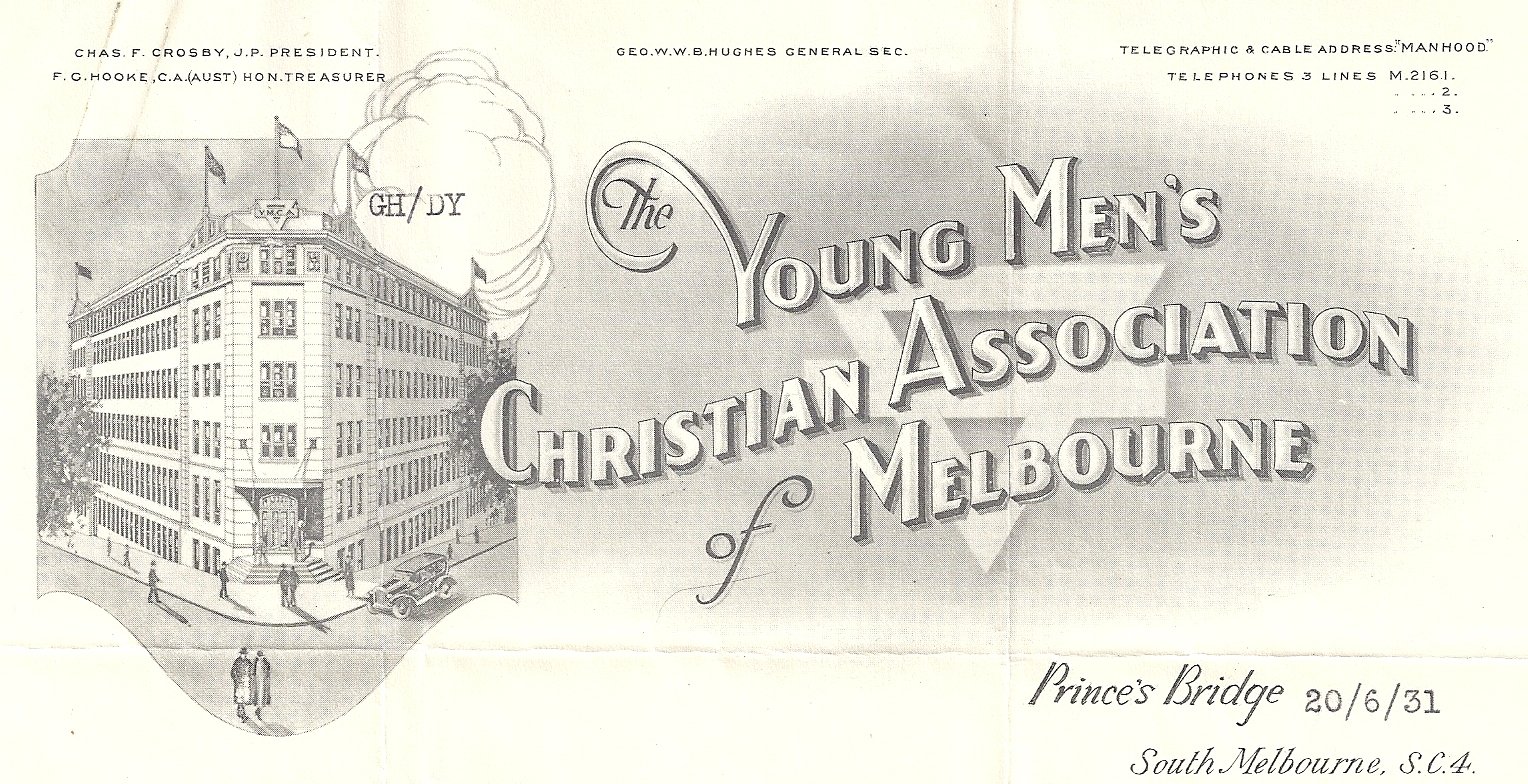
The YMCA letterhead from 1931, scanned from one of George's letters.
The Melbourne YMCA is such a prominent character in George's letters, but frustratingly, it isn't easy to find a significant summary of its history on the Internet.

The eMelbourne website, which is an online encyclopedia of Melbourne, includes this information:
"By 1924 Melbourne boasted the largest YMCA in the southern hemisphere. Its new premises opened in City Road near Princes Bridge in 1925, and a decade later membership stood at over 2000 men and boys...

After a long period of decline, the Melbourne YMCA closed down in 1980, many of its functions being taken over by the Victorian State YMCA." 

Note that the "decade later" statement above refers to the 1930s when George was general secretary and writing these letters.

The Melbourne YMCA in 1974
(Original courtesy of Lindsay Bridge via Flickr
and edited version courtesy of Michael Williams via Flickr)
The YMCA building where George worked was located near the Prince's Bridge in South Melbourne. A contact on Flickr, Michael Williams, who lived at the Melbourne YMCA in the mid 1960s and has a photo set devoted to his time at the Y, remembers the address as 2 City Road.

Regardless, the building was demolished during the development of the nearby Arts Centre complex.

The Prince's Bridge area in
South Melbourne, 1945
(courtesy of the
University of Melbourne Map Collection)
The Prince's Bridge area in
South Melbourne, 2011
(courtesy Google Maps)
(A) denotes approximate location of YMCA


I was able to find a Melbourne Argus newspaper article from 12 Nov 1926 noting the opening of the then new Melbourne YMCA building. The article, about the YMCA's Armistice Day observances, notes that the association's new building stood as "a perpetual reminder of the splendid work done by the association during the war, and of the hundreds of Y.M.C.A. members who had served with the A.I.F."

Clipping from The Argus (Melbourne) Friday 12 Nov 1926
Courtesy of Australia Trove digitized newspapers and more
In this case, "perpetual" means only 54 years, which is actually a good run for a building in a thriving city in the 20th Century, I guess.

On a personal note, I remember touring Melbourne in 1980 and visiting what was, I think, the YMCA building, and being told it wouldn't be around for much longer. I remember being shown George's name on a wall placard somewhere. I wish I'd paid more attention, but I was only 11 years old then. Maybe a search of old family photos will turn up something. 

I also found it interesting to note that an Internet search of "Young Men's Christian Association of Melbourne" turns up many Y publications that exist in library collections today, which is consistent with repeated statements that George includes in his letters about distributing the publications and donating them to libraries.

25 September 2011

The girlfriend at home and other tidbits

This next letter is the first letter where we see mention of Kath Lilford, who is the girlfriend that Noel left behind and is diligently waiting for him.

The family at camp in Australia. Pictured are
(front, from left) Joyce, Edith, May, and
(back, from left) George and Kath.
The reference is buried in this letter (No. 11 -- 18 Aug 1931) under mention of the Carnival Queen contest. You wouldn't even notice that Kath's name has significance here, but it becomes more obvious as the letters continue and time passes.

In a time-line in Noel's family history, Noel writes that he had a "very close relationship" with Kath Lilford "when he went to U.S.A. in 1931."

The back of the photo. I believe the date
is January 1932, not 1938 as it looks on first glance.
Long-distance relationship have always been difficult, and this one appears doomed from very early on, as Noel meets Marion C. Smith
(whom he will later marry) in the autumn of 1931 (although she doesn't appear in the letters for quite a long time.)

On some issues in these letters I think it will be more interesting to let them play out without any spoilers, but on the Kath Lilford issue, I think it's more interesting if you know this information early on.

Also of interest, once Noel and Kath terminate their relationship, they don't appear to have any contact until March and April, 1986, after Marion's death. While visiting Australia, Noel looks up Kath and has lunch with her and her husband.

Family News

I love the references to Edith and Joyce in this letter. It really paints a picture of their characters, and their attitudes feel very timeless.
Joyce looks at her and just simply says one word -- "mad"!

They were definitely a bright spot in George's life.

Immigration issues

I thought it was interesting to note in this letter the reference to the problems that Noel had with Immigration authorities. George didn't find it surprising, and I don't either, since Noel would be a red-flag on immigration even today -- a 21-year-old with very little cash coming into a country deep in Depression where jobs are scarce.

I wish I knew more of the story, though.

Finances at the YMCA

Also of interest to me were the references in the past few letters to all the pay cuts at the YMCA and how difficult fund-raising has been.

Pair that with all the references to people leaving their jobs at the YMCA, and you see how dire things were. Somewhere in Noel's papers, I remember reading that at one point George almost had to find other work also. I'll post that reference when I find it.

See related post: -- (No. 11 -- 18 Aug 1931)

21 September 2011

Who was George WWB Hughes?

Geo. W.W.B. Hughes in an undated photo. Location unknown.
Now that we are almost 10 letters into this project, it seems like a good time to give some biographical information on the author: Geo. WWB Hughes, also known as George Wall Wall Bagot Hughes.

As an overview, I'll quote directly from Noel Hughes, who wrote this about his father:
"George W.W.B. Hughes was one of the outstanding leaders during the early 1900's in both New Zealand and Australia. He was a Christian Gentleman who believed there was good in everyone. He was close to his church but preferred to work through a lay organization for the common and individual good. He was a friend to everyone he met, never uttering a harsh word in criticism.

"He availed himself of every opportunity to reach and serve people, occupying church pulpits on Sunday when asked, leading community singing, serving on committees and with all groups concerned for the public welfare. ...

"He became known throughout the world as one of the leading men in the Young Men's Christian Association, the lay organization to which he had devoted his life."

In the early 1980s, when Noel put together his family history, he didn't have the advantage of the Internet for research. So, I've borrowed liberally from his research, and added some of my own.

The Early Years in Adelaide

1878 -- George is born in Adelaide, South Australia, to Mary Ellen Hextell and George Wall Wall Bagot.

1880 -- George's mother marries Samuel Christopher Hughes, and George starts using the surname Hughes.

1882 -- George has a little sister, Edith Eleanor Hughes.

Sturt Street School in Adelaide,
where George attended school
in the 1880s. (Courtesy of
About Time: South Australia's
History Festival via Flickr
)

George is educated at Sturt Street School, which was constructed in 1883 and is one of the oldest primary schools in South Australia still operating today.

He continues his education at Angas College, described as "an interdenominational missionary training school" in a Wikipedia article about Australian Lutheran College, which operates at the site today.


Angas College was the first Bible college in Australia and was established in Adelaide in the 1890s by Presbyterian minister, Rev W Lockhart Morton, according to the Ministry Blue and SA Memory websites.

George is a sportsman, participating in activities including swimming, cross-country running, football, lacrosse and tennis.

His first occupations are in the printing trade with the "Advertiser" office (presumably the newspaper The Advertiser in Adelaide) and publishers Vardon & Pritchard in Adelaide.

It may be at Vardon & Pritchard that George formed his connection with the Young Men's Christian Association, as Joseph Vardon also had a connection with the YMCA, serving as its president in Adelaide from 1904-08, according to his biography.

Settling into a Career and Family Life

1903-1906 -- Now 25 years old, George begins his career in the YMCA, working as the Assistant Secretary of Our Boys Institute, Adelaide. According to Wikipedia, it was a junior branch of the YMCA with programming for boys ages 13-18.

1904 -- George, at age 26, marries Harriet Adelaide May McLaughlin, referred to as "May", at the Flinders Street Presbyterian Church in Adelaide.

Throughout his life, Geo. W.W.B. Hughes lives in:
(A) Adelaide, South Australia, (B) Dunedin, New Zealand
(C) Wellington, New Zealand, and (D) Melbourne, Victoria
1905 -- George and May's first son, Keith, is born.

1907-08 -- George works as the Physical Director at the YMCA in Adelaide.

1907 -- George studies at the University of Adelaide. According to the University Calendar for that year (found online on Google Books) he is listed as a non-graduating student, which I'm guessing means that he wasn't in a degree program.

1907 -- George and May's first daughter, Ester, is born. She dies that same year.

The New Zealand Years -- the Family Grows

Clipping from the Evening Post (Wellington)
25 Oct. 1913 found via Papers Past.
1909 -- The family moves to Dunedin, New Zealand, living at 368 High Street, and later on Russel Street and then on York Place.

1909-17 -- George works as the General Secretary for the YMCA in Dunedin, New Zealand.

1909 -- George and May have another son, Noel.

1912 -- George and May have another daughter, Ruth.

1917 -- George and May have another daughter, Joyce.

The Great War

Geo. W.W.B. Hughes (front row, far right)
is pictured outside the Shakespeare Hut
in London c. 1918. The Shakespeare Hut,
15 Gower Street, was the headquarters of the
New Zealand YMCA
in London during World War I.
(See this old newspaper clipping.)
1917-19 -- George, at age 38, travels to London, England, and takes a position as Supervising Secretary for the New Zealand YMCA Army Work during World War I. During this time he travels British, Canadian, New Zealand and American war fronts, even coming under shell fire.

1918 -- George is awarded the honor "Member of the British Empire" by King George V of England for his service to the New Zealand troops in England and France.

Clipping from the Fielding Star
(Manawatu-Wanganui)
24 May 1919 found via Papers Past.
According to Wikipedia, the honor was created in 1917 because King George V "wished to honour the many thousands of people who had served in numerous non-combatant capacities during the First World War. Originally, the Order included only one division; however, in 1918, soon after its foundation, it was formally divided into Military and Civil Divisions."

In a Supplement to the London Gazette, 7 JUNE 1918, page 6730, found online here, George is listed under "To be Members of the said Most Excellent Order:"

Return to New Zealand -- the Family Grows More

1919 -- George returns to New Zealand following his work in Europe, and the family moves to Wellington, residing at Lyall Bay.

1919 -- George travels New Zealand, giving lectures and presentations about the YMCA's work in Europe to support the troops.

1919-24 -- George works as the National Secretary for the New Zealand YMCA, Wellington.

1920 -- George and May have another daughter, Edith May.

On to Melbourne
A clipping found online from
The Argus (Melbourne)
10 Nov 1924, page 7.

1924 -- George, now 46, and his family move to Melbourne, Australia, living temporarily at Toorak, and Burke Road, Camberwell, before finally taking up residence at 33 Currajong Road, Hawthorn.

1924-40 -- George works as General Secretary of the Melbourne YMCA.

1938 -- George is the first speaker to the youth of Australia on the first "Carols by Candlelight" broadcast on national radio. According to Wikipedia, "The first ever such event was held in Alexandra Gardens the following Christmas, 1938, and was attended by around 10,000 people." Carols by Candlelight remains a popular Christmas tradition today in Australia.

1940 -- George dies of a heart attack at age 62.

In the family history there is an undated obituary clipping from an unknown newspaper. Under the headline "His Work Endures", it attributes Mr. Leslie Jenner, president of the Melbourne YMCA, as saying about George:
"Mr Jenner says that he never knew him to say one unkind word. That is something worth living for, enhancing the value of all his wide influence on the lives of boys and youths among whom he worked in Melbourne. ...

"'There are 2000 members of the Y.M.C.A. who will sadly miss his friendship, but there are a great many more than that, who have come under his inspiring influence, and who will forever be grateful for his friendship. That is his finest memorial.'"

With the wealth of information available on the Internet, I know there is more out there to be found about George's life, especially with his work related to World War I. Expect future posts.

Geo. W.W.B. Hughes (back row, second from left) outside
the New Zealand headquarters in London, c 1918.